
Clarke County Release Date Types
“Release date” can describe several different facts. An actual release date records when physical custody ended. A projected date is the agency’s present calculation for a sentenced person. A parole date is set through a separate Board process. A Tentative Parole Month, or TPM, marks a future review stage and is not a final release decision. A federal Release Date belongs to the Bureau of Prisons and should not be mixed with a Georgia or Clarke County record.
A Clarke County Jail detainee held before trial generally has no fixed sentence-completion date. Release can result from bond, dismissal, court order, transfer, disposition, or another lawful reason. The sheriff’s booking and release record carries the actual local event. A sentenced person at the Athens-Clarke County Correctional Institution follows the state-offender path through the Georgia Department of Corrections, or GDC, and possibly the State Board of Pardons and Paroles.
| Date term | What it means | Best source |
|---|---|---|
| Actual jail release | Physical exit or transfer from sheriff custody | Sheriff release record |
| Projected prison release | Current GDC sentence calculation | GDC Find an Offender |
| Tentative Parole Month | Month for final Board review | Board TPM Lookup |
| Federal Release Date | BOP actual or future projected date | BOP Inmate Locator |
Lookup Clarke County Release Dates
Begin by identifying the facility. For a state prisoner, use GDC Find an Offender. Georgia describes searches by name, GDC ID or case number, age, and other identifying details. A result may show charges, facility location, status, and release date. Match more than a name. GDC ID, case number, age, and descriptors help prevent a false match.
For Clarke County Jail, use the current list only to test present custody. A released person usually drops off it. The seven-day arrest display may preserve a recent booking, but it is not a release feed. The court docket can explain bond, sentence, jail credit, or disposition. Ask the sheriff for the booking and release record when the exact physical date or reason matters. The Clarke County release-record path covers that official request.
- Identify whether the person is in the county jail, a GDC facility, federal custody, or already under supervision.
- Search GDC by name plus an ID, case number, age, or other known fact for a state sentence.
- Read status, facility, sentence lines, and the listed release date in context.
- For a parole candidate, check the Board TPM tool and remember that a TPM is tentative.
- For a county jail case, compare the sheriff custody record with the sentencing court docket.
- Confirm the final event with the agency that held the person.
Note: A missing jail-roster entry is a clue, not proof of the date, reason, or destination of release.
Clarke County Parole Date Lookup
The Inmate TPM Lookup answers a narrower question than the GDC date. The Georgia State Board of Pardons and Paroles says a TPM is the month when it plans to complete final review and, if appropriate, set a parole release date. Good conduct and completion of treatment or other preconditions may affect that process. The Board may reconsider a prior decision before release.
The official TPM page shown in the manifest illustrates that parole timing belongs to the Board rather than the county jail.
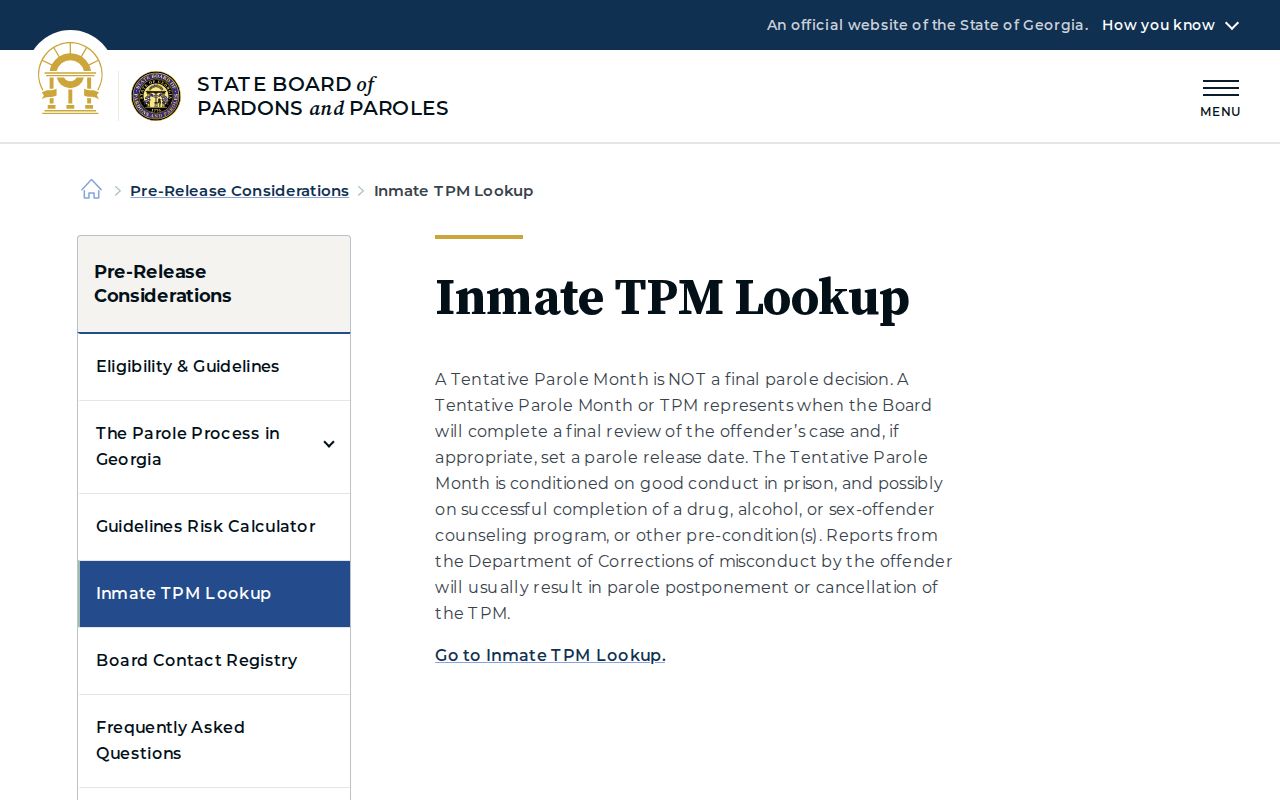
Use the TPM with the GDC custody record, not in place of it. A future month does not show that the person has left prison. After parole begins, the Board’s parolee search may show begin and end dates, status, and the assigned office. The Clarke County post-release supervision page explains that later record.
Clarke County Release Credits
Georgia’s Performance Incentive Credit Program, or PIC, gives eligible state offenders ways to reduce length of stay through satisfactory progress. GDC identifies education, vocational work, treatment programs, work assignments, and good behavior as relevant program areas. O.C.G.A. § 42-5-101 authorizes work incentive credits based on academic or vocational gains, work performance, and compliance with behavior standards.
The GDC program capture shows the official state source for these credits.
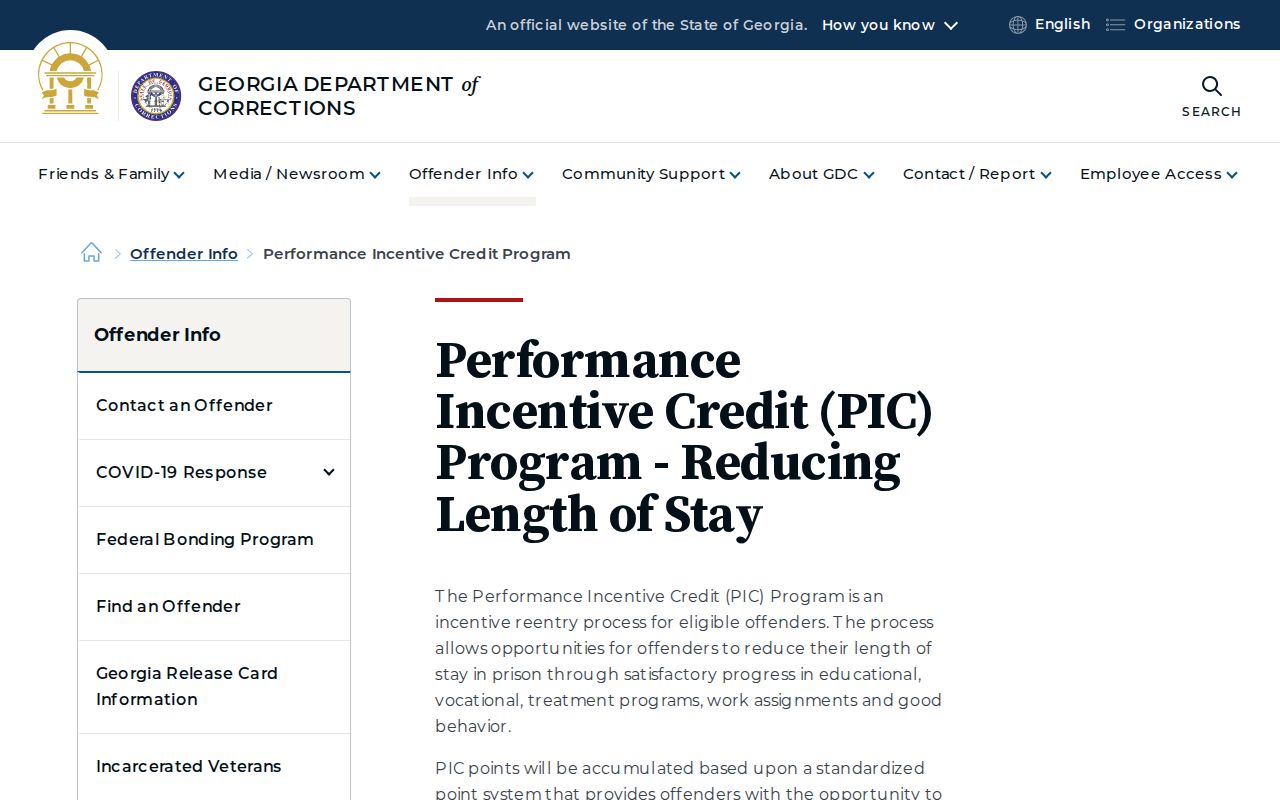
PIC and work credits are state-prison calculations. They should not be applied to a Clarke County Jail bond-out or guessed for a short county sentence. A credit may be unavailable, unearned, lost, or barred by the sentence. GDC performs the calculation for its prisoners. The listed projected date is the practical result to use unless GDC issues a new one.
- Jail credit
- Time a sentencing court credits toward a sentence for prior custody.
- Incentive credit
- An authorized reduction tied to eligible conduct, work, or program progress.
- Detainer
- A request or hold from another authority that may prevent release to the community.
- Mandatory minimum
- A term the law requires to be served without specified reductions.
Georgia Release Date Restrictions
Georgia does not have one universal rule that every inmate serves 85 percent of a sentence. O.C.G.A. § 17-10-6.1 governs serious violent felony sentencing and states that covered mandatory minimum terms cannot be reduced through parole, pardon, earned time, early release, work release, or other sentence-reducing measures. Other cases may qualify for parole consideration or incentive credits under different laws and agency rules.
O.C.G.A. § 42-9-45 provides general parole-consideration baselines. Misdemeanor inmates are generally considered after six months or one-third of the sentence, whichever is greater. Felony inmates generally reach consideration after nine months or one-third, subject to exceptions. Consideration is not release. The Board keeps discretion, and mandatory minimum, repeat-offender, serious violent felony, and other rules may control.
The serious violent felony statute is captured in the project manifest as the source for the no-reduction rule.
The sentence and offense control which rule applies. Do not use a broad percentage to calculate a date from the sentence alone.
Clarke County GDC Release Fields
A useful GDC result is more than one date. Capture the GDC ID, full name, status, current facility or lack of one, sentence and offense lines, and each date label shown. A photo and personal descriptors may help distinguish two people with similar names. If the record includes a maximum or projected release date, preserve the label. Do not rename a maximum date as a parole date or treat a projected date as an actual discharge.
The GDC status and location explain which calculation matters. A current facility points to state custody. A released or discharged status paired with a past date supports a completed state event. A parole link points to a separate Board record. The Athens-Clarke County Correctional Institution houses state and county offenders in the GDC network, so its residents follow this state-offender lookup path rather than the sheriff jail roster.
| GDC field | Release-date use |
|---|---|
| GDC ID or case number | Confirms the correct record |
| Status | Separates present custody from a completed release |
| Facility | Identifies the agency holding the person |
| Release date label | Shows the agency’s current date and whether it is future or past |
| Sentence and offense | Provides context for statutory limits |
| Parole reference | Routes the search to the Board record |
Public search results are summaries. When a formal discharge record is required, ask GDC for the official release date, release type, facility, sentence information, and public supervision transition. A sheriff records request is the wrong route for a GDC prison calculation.
Why Clarke County Dates Change
A projected release date changes when one of its inputs changes. Some changes shorten a calculated stay. Others extend it or block release to the community. A court correction can alter the sentence or jail credit. Program progress can affect an eligible GDC calculation. Discipline may cause the loss of available credit. A detainer or warrant can mean release from one agency becomes transfer to another.
| Factor | Possible effect | Where to verify |
|---|---|---|
| Sentence or jail-credit correction | Moves the calculated end date | Sentencing court and GDC or sheriff |
| PIC or work credit | May reduce eligible state-prison stay | GDC |
| Discipline or unmet condition | May delay a calculated date or parole action | GDC or Parole Board |
| Parole decision | May establish, deny, or revise a parole date | Parole Board |
| Detainer, warrant, or hold | May cause transfer rather than community release | Holding and requesting agencies |
| Court order | May change custody or sentence terms | Court docket and agency record |
“Released” can therefore mean release from one custody system, not freedom from every hold. If GDC closes its custody record but another authority takes custody, the GDC date can still be accurate. The destination field, court order, and the next agency’s locator resolve that distinction.
Clarke County Jail Date Calculation
No official Clarke-specific jail good-time formula or weekend-release rule was found in the reviewed sources. A local date can depend on the court sentence, jail credit, bond status, holds, warrants, court orders, and any lawful local calculation. State PIC rules must not be copied onto a sheriff jail sentence. Ask the Clarke County Jail or sentencing court to confirm a short sentence rather than counting days from a docket entry.
Pretrial cases are more fluid. A bond may be posted, modified, or revoked. A charge may be resolved. Another hold may remain. The court action and physical release may also occur at different times. The court record explains legal authority, while the sheriff’s release record supplies the actual exit time and release type. Both may be needed for a sound answer.
Confirm Clarke County Release Dates
Use the agency that owns the calculation. GDC confirms state-prison dates. The Parole Board confirms TPM and parole decisions. The sheriff and sentencing court confirm county jail dates. BOP handles a federal Release Date, and VINE can send participating-agency custody-change alerts. VINE is useful for notice, but it is not a sentence worksheet or complete court file.
Check again near the projected date. Review status and location, not the date alone. If the person remains listed in custody, the release has not occurred. If the person disappears, verify the completed record before assuming a destination. A final sheriff, GDC, Board, BOP, or court record is stronger than a copied date or an old screen.
Federal and immigration records require their own tools. A future date in the BOP Inmate Locator is a federal projection, while “Released” or “Not in BOP Custody” means only that BOP custody ended. ICE’s locator shows current immigration detention rather than a criminal release archive. If a Clarke County jail exit involved a detainer or transfer, check the receiving system instead of assuming release to the community.