
Clarke County Supervision Types
Parole and probation both place a person in the community under rules, but they begin in different ways. The Georgia State Board of Pardons and Paroles decides parole for eligible state prisoners. Parole is conditional release from a prison sentence before the sentence fully ends. The Georgia Department of Community Supervision, or DCS, then supervises felony parolees in the community. Probation is part of a court sentence. It may follow jail time, form part of a split sentence, or begin without a prison term.
Clarke County has two probation routes. DCS handles felony probation as well as felony parole. Athens-Clarke County Probation Services handles local misdemeanor probation ordered through courts with misdemeanor authority. Someone released from Clarke County Jail after a misdemeanor disposition may never appear in the state parolee system. The court docket and local probation office are then more useful. By contrast, a person released from a GDC prison on parole may appear in the Board’s parolee search even after the prison location disappears.
| Supervision | How it starts | Clarke County verification |
|---|---|---|
| Parole | Board-approved conditional prison release | Board Parolee Search, then DCS office |
| Felony probation | Superior Court sentence | Court record and DCS Athens |
| Misdemeanor probation | Local court sentence | Court record and Athens-Clarke County Probation Services |
- Parole
- Conditional release from a state prison sentence under Board rules.
- Probation
- Court-ordered community supervision that is part of a sentence.
- Discharge
- The formal end of a sentence or supervision term.
- Absconder
- A supervised person alleged to have stopped reporting or left supervision without approval.
Check Clarke County Supervision
First decide whether the person is still in state custody, released on parole, or serving probation. The Board’s Inmate TPM Lookup serves a person who remains in prison and is being considered for parole. A Tentative Parole Month, or TPM, is not a final date. The Parolee Search is the better post-release tool. It accepts fields such as first and last name, race, case number, UPI number, and GDC ID. Partial terms are allowed.
A matching parolee result may show parole begin and end dates, the parole office and phone, the primary offense, identifiers, and status details. The assigned office can depend on residence rather than the county of conviction. A person living outside Clarke may therefore report elsewhere. For probation, read the sentencing court docket. Superior Court felony records may lead to DCS, while misdemeanor records may lead to the local county office. Follow these steps:
- Use the Board parolee search for a person who has left state prison on parole.
- Match the result with a GDC ID, case number, or other known detail.
- Read the parole dates, status, and assigned office rather than relying on a name alone.
- For felony probation, confirm the sentence in the Superior Court record and contact DCS.
- For misdemeanor probation, check the local court record and Athens-Clarke County Probation Services.
For the underlying release record, use the Clarke County released-inmate search and records path. It can distinguish physical release from a later supervision record.
Clarke County DCS Release Office
The DCS Athens Field Office is the named local point for felony parole and probation. It serves Clarke, Oconee, and Western. DCS says its statewide work covers felony individuals granted parole or a reprieve and those serving probated or split sentences. The office provides supervision context after release, but it is not a public jail roster and does not replace the Board’s searchable parole record.
171 Old Epps Bridge Road
Athens, GA 30606
Phone: (706) 369-6000
Monday-Friday, 8:00 a.m.-4:30 p.m.
The manifest capture from the official Athens Field Office page shows the local office entry used for Clarke County release supervision.
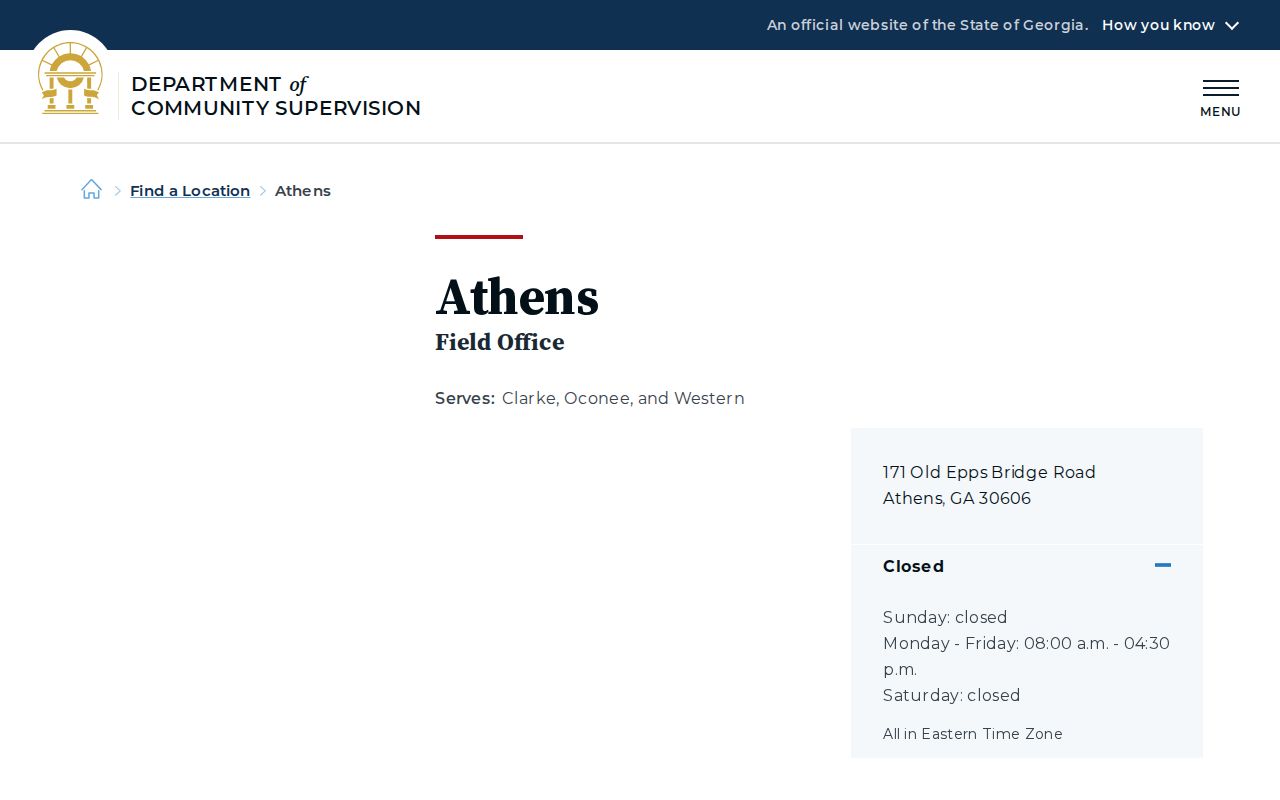
That listing is the right source for office contact and service area. A person-specific status should still be checked through the Board, the sentencing court, or an authorized office record.
Clarke County Misdemeanor Probation
Athens-Clarke County Probation Services has probation and supervisory authority for misdemeanor offenses allowed by Georgia law. Its work includes supervision, counseling, and collection services tied to sentence terms. This local office may be the key after a person leaves Clarke County Jail following a State Court, Municipal Court, Magistrate Court, or other misdemeanor sentence. A state parole search will not show ordinary misdemeanor probation.
110 Bray Street
Athens, GA 30601
Phone: 706-613-3911
Monday-Friday, 8:00 a.m.-5:00 p.m.
Start with the court docket because it proves what the judge ordered. A probation office can then confirm office procedure or route a lawful records inquiry. Do not infer probation from the mere fact that a person left jail. Bond, time served, dismissal, transfer, and other lawful release types can also end jail custody.
Clarke County Parole Status
The Georgia parole process separates consideration from actual release. For a non-life sentence, the Board may deny parole or set a future TPM. It may reconsider a prior decision before release. Final review can also depend on good conduct and completion of treatment or other preconditions. Georgia does not publish an ordinary county-by-county monthly hearing calendar for standard parole decisions. The public route is the TPM lookup before release and the parolee search after release.
O.C.G.A. § 42-9-45 provides baseline parole-consideration timing and exceptions. In general, felony consideration may begin after nine months or one-third of the sentence, whichever is greater, while misdemeanor timing has a six-month or one-third baseline. Serious violent felony rules, repeat-offender provisions, mandatory minimums, and other restrictions can change that result. Eligibility means the Board may consider the case. It is not a promise of parole or proof of release.
O.C.G.A. § 42-9-46 also governs notice and objections in certain early-consideration cases. The Board can set a future month, deny parole, impose preconditions, or later set a release date. A GDC custody record and Board status should be read together when a person has not yet left prison.
Note: A TPM describes a future review point; only an actual custody change and official record confirm release.
Clarke County Release Warrants
The Clarke County Sheriff’s Wanted Fugitives page is a local warrant channel, not a complete parole or probation absconder list. It can matter when someone was released and later became wanted. The page publishes selected named fugitives, sheriff contact details, an anonymous warrant tip route, and Crime Stoppers information. Its absence of a name does not prove that no warrant exists.
A supervision violation also does not always mean a new jail booking has occurred. An alleged breach may lead to an office response, warrant, arrest, or revocation hearing. A revocation is a court or Board process that can change the supervision term or return a person to custody. Verify a public warrant through law enforcement or the court. Urgent sightings belong with law enforcement, not a supervision-status search.
Clarke County Release Reentry Support
Clarke County’s Re-entry Quality Support program, known as REQS, is a distinct local transition service. The sheriff says jail residents can request help through a tablet or kiosk. Staff identify needs and coordinate with community resources as residents prepare to return to the community. REQS is not a parole lookup, probation office, or release confirmation service.
The program fits before release planning, while DCS or county probation applies after a court or Board has imposed supervision. Those roles should not be blended. A REQS contact may help a jail resident address transition needs, but the sheriff release record still confirms a jail exit. The Board and DCS records establish felony parole status. Court and local probation records establish misdemeanor supervision.
Clarke County Release Property Questions
The county publishes detailed jail property intake rules, including that property is not accepted in the jail lobby and that approved items must arrive by mail or shipment. It does not publish a separate post-release property-pickup procedure. Contact the Clarke County Jail or sheriff for an actual release-property issue instead of assuming that intake rules explain pickup.
This distinction is practical. A supervision office does not control jail property. DCS manages felony community supervision, while Athens-Clarke County Probation Services manages local misdemeanor supervision. The sheriff controls jail operations and can explain what happened to property held with a booking. Keep the booking number and release date ready when asking so staff can identify the correct custody event.
Clarke County Supervision Discharge
Supervision ends through a formal discharge, expiration, court order, or other official action, depending on the sentence. A parole end date in a Board result is useful, but current status still matters. A probation term may be changed by a judge, extended where law permits, revoked after due process, or terminated through an order. The most durable proof is the originating agency or court record.
Ask for the document that states the end of supervision. For parole, that may be a Board or DCS record. For felony probation, use the sentencing court and DCS. For misdemeanor probation, use the local court and Athens-Clarke County Probation Services. “Not in custody” is not the same as “off supervision,” and an old roster cannot answer either question by itself.