
Institution Release Paths
Athens-Clarke County Correctional Institution is not the Clarke County Jail. The county corrections department operates it within Georgia’s county correctional institution network. It houses adult male felons at medium security. Release is tied to a state sentence and the Georgia State Board of Pardons and Paroles, not a same-day sheriff bond-out. The county’s Offender Information page says the facility houses Georgia state inmates and that the Board determines release.
A person may leave through parole, full sentence discharge, transfer to another GDC facility, or another authorized state-offender movement. Parole places the person in the community under conditions. Discharge ends the state custody term shown by the controlling record. Transfer means custody continues elsewhere. A missing facility name is not proof of release to the community.
| Outcome | Next status | Confirmation |
|---|---|---|
| Parole | Community supervision | Board and DCS |
| Discharge | GDC term ends | GDC record |
| Transfer | Custody elsewhere | GDC facility field |
| Other hold | Another agency may hold | GDC and receiving agency |
Confirm Institution Release Status
Start with GDC Find an Offender. Georgia describes searches by name, ID or case number, age, and other identifying facts. Results may show charges, facility, status, and release date. Search with more than a name. A GDC ID, case number, age, or descriptor can separate similar records.
Read status and facility before the date. A current institution listing points to ongoing custody. A different facility suggests transfer. A released or discharged status with a past date supports a completed GDC event. If parole is involved, use the Board parolee search for begin and end dates, status, and office.
- Search GDC by full name and a known identifier.
- Record the GDC ID, status, facility, and date label.
- Use TPM Lookup if the person remains in custody.
- Use Parolee Search after a parole release.
- Confirm local supervision through DCS when the record points there.
- Request the formal record if the summary is not enough.
The Clarke County released-inmate record path helps when custody moved between systems.
Institution Release Record Fields
A GDC result is a state-offender record. Useful fields include GDC ID, name, status, facility, sentence or offense lines, release date, maximum or projected date if shown, parole references, and a photo if displayed. Preserve each label. A projected date is a current calculation, while a past date paired with completed status supports an actual event.
| Field | Use |
|---|---|
| GDC ID | Confirms identity |
| Status | Shows custody context |
| Facility | Shows reported location |
| Release date | Agency date read with status |
| Sentence | Explains custody term |
| Parole link | Routes to Board record |
A Tentative Parole Month is not proof of release. It marks the month for final Board review and possible setting of a parole date. Conditions, conduct, and later review may change the outcome.
Institution Release Records Contact
Athens-Clarke County Corrections Department provides the local facility contact. GDC and the county publish different ZIP codes for the same County Farm Road site, so use the full institution name, street, and phone. Ask whether the record belongs with county corrections, GDC, or the Board.
2825 County Farm Road
Athens, GA 30601
Phone: 706-613-3400
Fax: 706-613-3404
Monday-Friday, 8:00 a.m.-5:00 p.m.
The official department page is captured for the local operator.
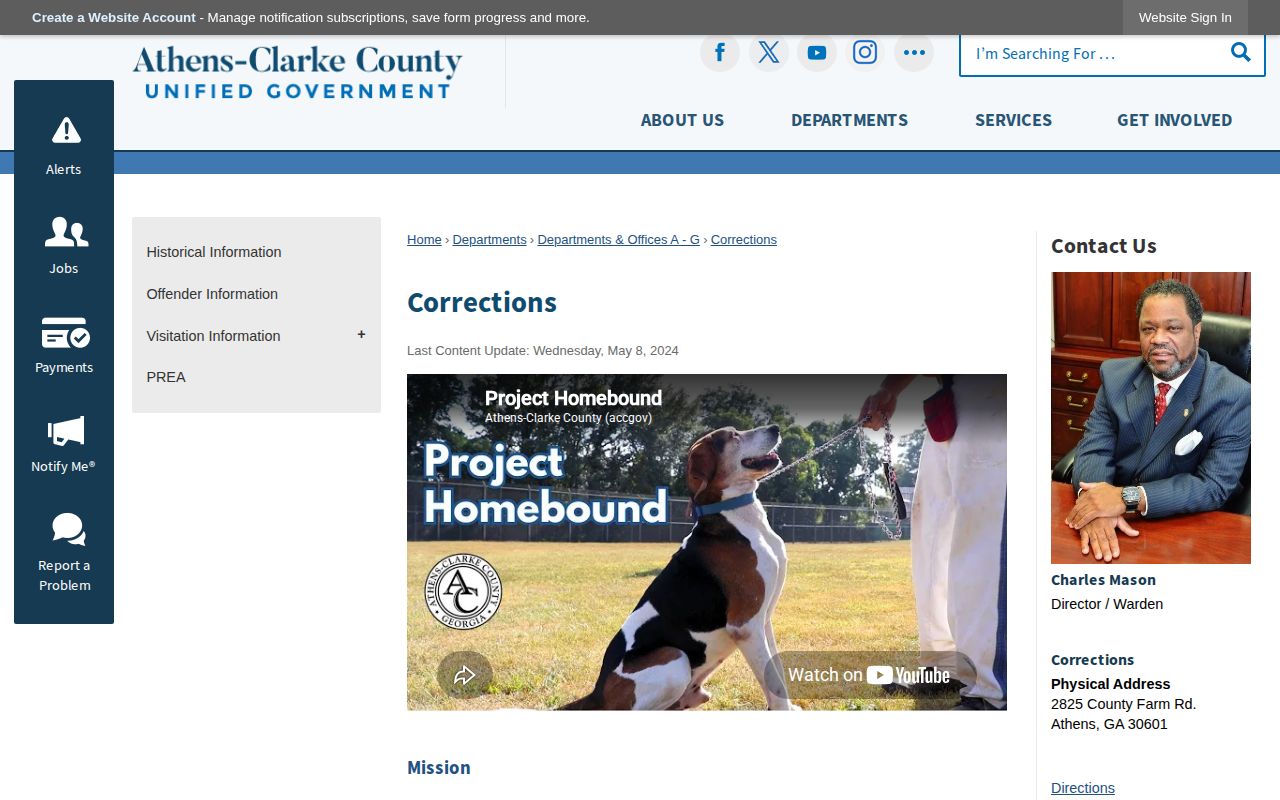
It confirms department identity and contact. Person-specific release status still belongs with GDC and, when applicable, the Board.
Request Institution Release Records
For records held by Athens-Clarke County Corrections, the county lists Police/Corrections Open Records at 3035 Lexington Road, Athens, GA 30605, phone 762-400-7000 and fax 706-613-3348. Use its online records center. Do not route an institution request to the sheriff unless the record belongs to the jail.
State release records belong with GDC. Ask for full name, GDC ID, facility, release date and type, sentence information, and any public supervision transition. Parole decisions belong with the Board. O.C.G.A. § 50-18-71 permits reasonable production costs, gives the first 15 minutes without charge, and caps letter or legal paper copies at ten cents per page.
Institution Release History
The GDC facility profile gives the institution a distinct local history. It was built and opened in 1987. GDC classifies it as medium security with capacity for 112. Its mission includes housing state and county offenders and providing labor that supports Athens-Clarke Unified County Government. This explains why it is locally run but follows a state-offender release path.
The official GDC profile captured for the project shows that network context.
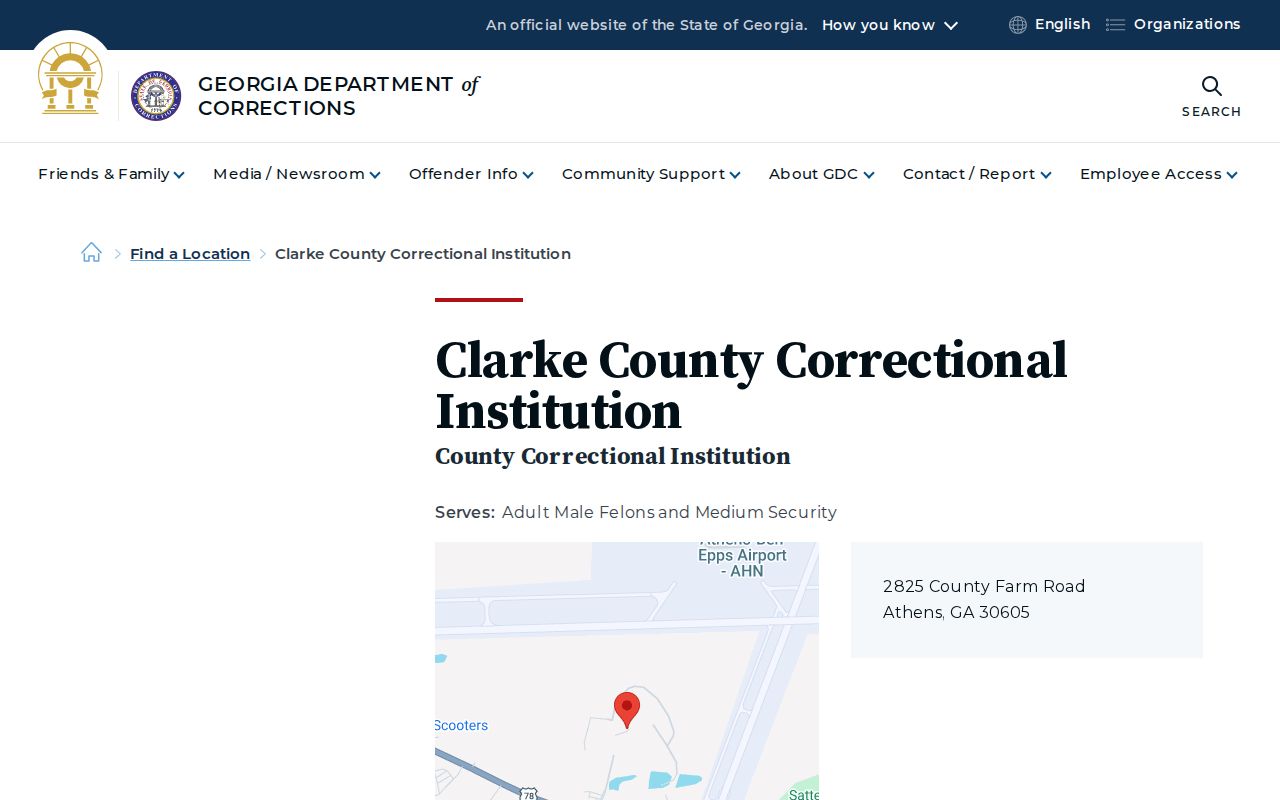
Housing includes three dormitories with 110 beds, four isolation or segregation cells, and a one-bed infirmary. Work details aid county departments, the Georgia State Patrol, and the Northeast Georgia Police Academy. Programs include GED, recovery groups, reentry, recreation, and religious activities.
Institution Parole Release Process
The Georgia parole process belongs to the State Board. It may set a future TPM, deny parole, impose preconditions, set a release date after final review, or reconsider before release. Georgia has no ordinary county-by-county public calendar for standard consideration. TPM and parolee tools are the public paths.
O.C.G.A. § 42-9-45 supplies general consideration rules and exceptions. Eligibility is not a right to release. Serious violent felony terms, mandatory minimums, repeat-offender rules, and other limits may control. Read GDC and Board records together.
Institution Release Supervision
DCS supervises felony parole and probation. Its Athens Field Office serves Clarke, Oconee, and Western from 171 Old Epps Bridge Road, with weekday hours and phone (706) 369-6000. It may become the local office after parole, based on residence and assignment. It is not a prison locator or release-date calculator.
A parolee result may show dates, office, offense, identifiers, and status. A fully discharged person may have no active DCS tie. Do not assume all institution releases become parole.
Institution Release Date Changes
A future GDC release date can move when the agency receives a corrected sentence, applies jail credit, updates eligible incentive credits, records discipline, receives a detainer, or acts on a parole decision. The Performance Incentive Credit program may reward eligible progress in education, vocational work, treatment, work assignments, and good behavior. O.C.G.A. § 42-5-101 authorizes work incentive credits tied to attainment, work, and conduct.
Those credits are not available in every case. O.C.G.A. § 17-10-6.1 bars specified reductions for covered serious violent felony mandatory minimum terms. Georgia has no universal rule that each offender serves the same percentage. Read the sentence, statute, GDC date, and Board record together. The institution staff should not be asked to predict a date that belongs to a statewide sentence calculation.
A detainer can also change the destination without changing the fact that this institution released the person. The person may move to another authority instead of the community. Ask for release type and destination when the online record leaves that point unclear.
Institution Corrections Program Context
The county’s Offender Information page explains the local relationship in plain terms: Athens-Clarke County operates the correctional facility, it houses Georgia state inmates, and the State Board determines inmate release. That division of roles makes the source useful even though it is not a searchable release roster.
The institution lists GED instruction, Alcoholics Anonymous and Narcotics Anonymous, Motivation for Change, Re-Entry, recreation, and religious activities. Participation can support a person’s time in custody, but the public source does not promise that any named program produces release. GDC calculates eligible credits and the Board makes parole decisions. Program completion should be checked in the official record rather than inferred from a projected date.
Work details support county departments and other public agencies. That local mission does not turn a state offender into a county jail detainee. The controlling sentence, GDC ID, facility status, and Board action remain the core release facts.
Institution and Jail Release Boundaries
The sheriff jail holds local arrestees until bond, disposition, transfer, or lawful release. This correctional institution houses offenders in the state network. Sheriff current and seven-day pages cannot establish an institution discharge.
Use the Clarke County Jail release page only for a sheriff booking. Use GDC, the Board, DCS, and corrections records here. Release from one facility may still mean custody or supervision elsewhere.
Institution Release Records Beyond the Search
A public GDC result may answer current status without supplying the full administrative record behind a discharge or parole transition. When the displayed entry is not enough, request the narrow record from the agency that created it. Ask GDC or Athens-Clarke County Corrections for the release date, release type, facility, sentence details, and supervision transition that can lawfully be disclosed. Use the Board for parole-decision material and the court docket for the sentence imposed.
Those records should agree on the custody track even when their dates serve different purposes. A court sentence sets the legal term. GDC calculates and displays state custody information. The Board decides parole, and DCS handles community supervision after release. None of those records turns the institution into the sheriff jail or makes the county current-inmate list relevant to this state-offender release.